A Complete Guide to Thermic Fluid Heaters (EPT Series): Working, Benefits & Industrial Applications
TL;DR
- IBR Boiler Certification is a mandatory safety and compliance requirement for most industrial boilers operating in India.
- It is governed by the Indian Boiler Regulations (IBR) and focuses on safe design, manufacturing, testing, and operation.
- IBR-certified boilers undergo rigorous inspection, material traceability checks, and pressure testing.
- Using an IBR-certified boiler reduces safety risks, improves operational reliability, and ensures legal compliance.
- Non-IBR boilers may be suitable only for limited, low-risk applications where regulations allow exemptions.
Why IBR Boiler Certification Matters
Industrial boilers operate under high pressure and temperature conditions. A failure in a steam boiler can lead to serious safety incidents, production losses, and legal consequences. In India, boiler safety is not optional, it is regulated by law.
IBR Boiler Certification exists to ensure that boilers used in industrial environments meet minimum safety, design, and operational standards. It provides a structured framework for inspection and approval, helping plant owners, engineers, and regulators maintain safe and compliant boiler operations.
What Is IBR Boiler Certification?
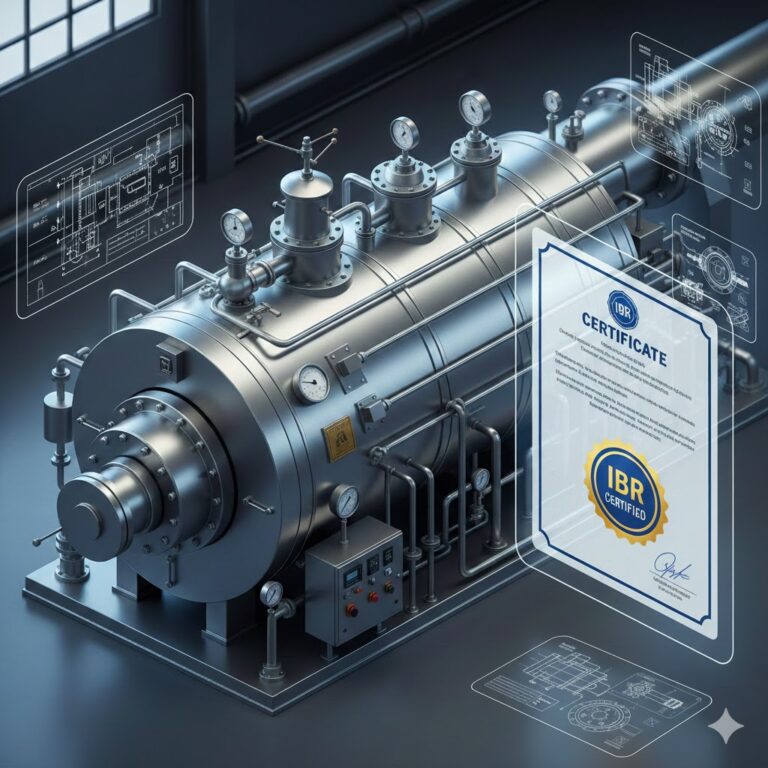
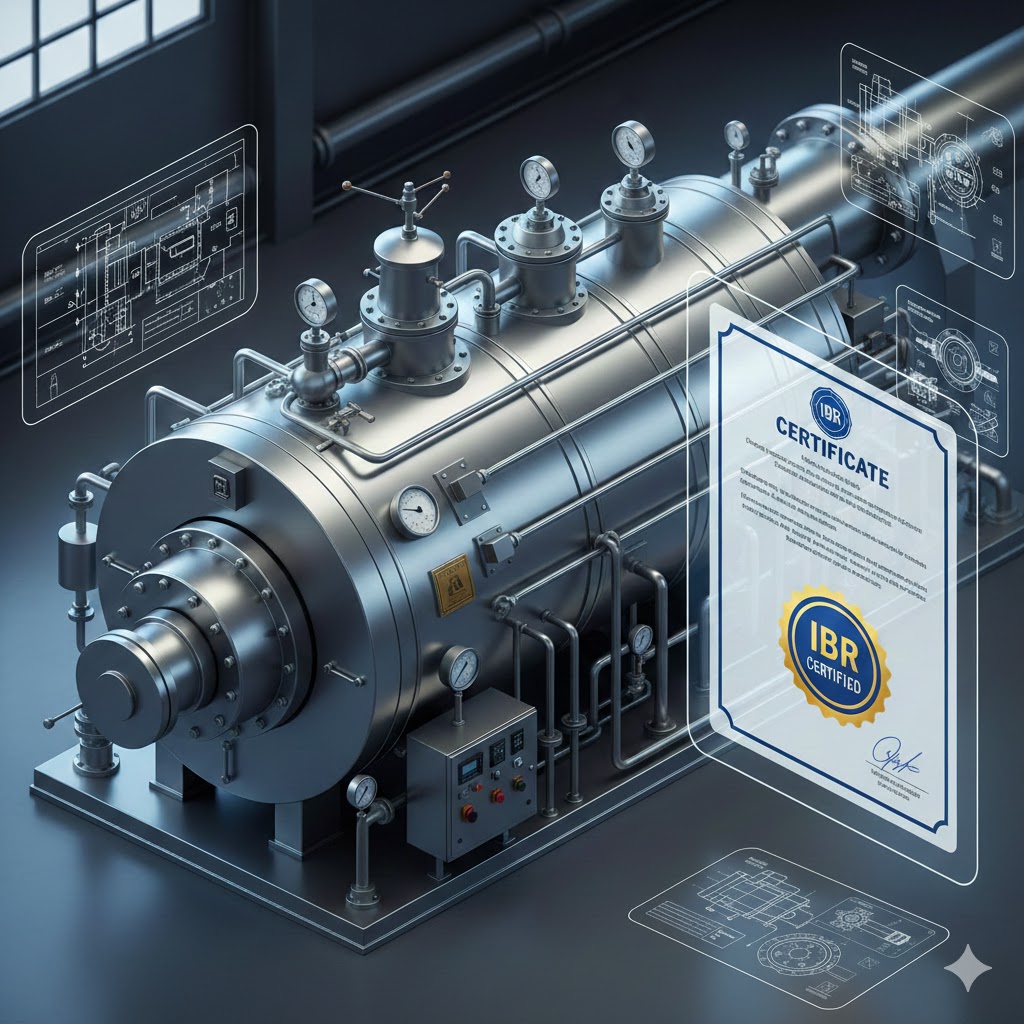
IBR Boiler Certification refers to the approval granted to a boiler or boiler component that complies with the requirements laid down under the Indian Boiler Regulations.
In simple terms, it confirms that:
- The boiler is designed as per approved codes
- Approved materials have been used
- Manufacturing and welding follow prescribed standards
- The boiler has passed mandatory inspection and testing
Once certified, the boiler can be legally installed and operated in applicable industrial settings across India.
Overview of Indian Boiler Regulations
The Indian Boiler Regulations (IBR) are statutory rules framed under the Boilers Act, 1923. These regulations define how boilers must be designed, manufactured, erected, inspected, and operated.
Key areas covered under IBR include:
- Boiler and pressure part design codes
- Approved materials and material traceability
- Welding procedures and welder qualifications
- Inspection and testing methods
- Certification and documentation requirements
IBR applies to most steam boilers, waste heat recovery boilers, and high-pressure industrial heating systems used in India.
IBR Boiler Approval Process
The IBR boiler approval process follows a structured sequence to ensure compliance at every stage.
1. Design Review and Approval
The IBR boiler approval process follows a structured sequence to ensure compliance at every stage.
2. Material Verification
All pressure parts must use approved materials. Material test certificates are reviewed to confirm chemical composition and mechanical properties.
3. Manufacturing Inspection
During fabrication, inspections are carried out at defined stages. Welding procedures and welder qualifications are verified as per IBR requirements.
4. Testing and Examination
Mandatory non-destructive tests, hydraulic pressure tests, and dimensional checks are conducted to validate structural integrity.
5. Certification and Documentation
Once all requirements are met, certification is issued. The boiler is then eligible for registration with the state boiler authority.
IBR Inspection and Testing Requirements
IBR inspection and testing are central to boiler safety compliance in India. These checks are designed to detect defects before the boiler is commissioned.
Common inspection and testing steps include:
- Visual inspection of pressure parts and welds
- Radiography or ultrasonic testing of critical weld joints
- Hydraulic pressure testing at prescribed pressures
- Verification of safety valve sizing and settings
These steps help ensure that the boiler can safely withstand operating pressures over its service life.
IBR Certified Boiler vs Non-IBR Boiler
Understanding the difference between an IBR-certified boiler and a non-IBR boiler is important for correct equipment selection.
IBR Certified Boiler
- Mandatory for most steam and high-pressure applications
- Approved by statutory authorities
- Suitable for regulated industrial environments
- Requires periodic inspection and renewal
Non-IBR Boiler
- Typically used for low-pressure or limited applications
- May be permitted under specific exemptions
- Not suitable where steam boiler regulations mandate IBR compliance
- Lower documentation and inspection requirements
Choosing a non-IBR boiler where IBR certification is required can result in legal penalties and operational shutdowns.
Industrial Boiler Safety Standards in India
Industrial boiler safety standards in India are closely aligned with IBR provisions. These standards aim to:
- Prevent boiler explosions and pressure failures
- Standardize manufacturing quality
- Ensure accountability across the boiler lifecycle
Compliance with boiler safety regulations also supports safer working conditions, reduces downtime, and improves long-term equipment reliability.
Applications Where IBR Certification Is Mandatory
IBR certification is generally required for:
- Steam boilers used in manufacturing plants
- Process heating systems using pressurized steam
- Power generation and cogeneration boilers
- Industrial facilities handling hazardous or high-temperature processes
Industries such as chemicals, textiles, food processing, pharmaceuticals, and refineries typically fall under mandatory boiler safety compliance in India.
Role of Manufacturers in IBR Compliance
Manufacturers play a critical role in ensuring IBR compliance. This includes:
- Designing boilers as per approved codes
- Using IBR-approved raw materials
- Maintaining full traceability and documentation
- Coordinating inspections with certified authorities
Experienced manufacturers help end users navigate regulatory requirements and reduce delays during approval and commissioning.
In a Nutshell
IBR Boiler Certification is not just a regulatory requirement—it is a structured approach to industrial safety and operational reliability. By enforcing standardized design, manufacturing, and inspection practices, IBR helps reduce risks associated with high-pressure boiler operations.
For industrial buyers and plant operators, understanding the certification process ensures informed decision-making, regulatory compliance, and safer long-term boiler performance.
FAQs
IBR Boiler Certification confirms that a boiler complies with Indian Boiler Regulations for safety, design, and manufacturing. It is required for most industrial steam boilers in India.
IBR certification is mandatory for most steam and high-pressure boilers. Certain low-pressure or special-purpose boilers may be exempt based on regulatory provisions.
The process includes design approval, material verification, manufacturing inspection, testing, and final certification by an authorized authority.
IBR-certified boilers require periodic inspections as defined by state boiler authorities to maintain compliance and operational approval.
IBR boilers meet statutory safety standards and are legally approved for regulated applications, while non-IBR boilers are limited to specific, lower-risk uses.
They provide a legal and technical framework to ensure boiler safety, reduce accident risks, and standardize industrial boiler operations.
In most cases, upgrading is complex and may require redesign, re-fabrication, and fresh approval, making replacement more practical.
Lorem ipsum dolor sit amet, consectetur adipiscing elit. Ut elit tellus, luctus nec ullamcorper mattis, pulvinar dapibus leo.
Lorem ipsum dolor sit amet, consectetur adipiscing elit. Ut elit tellus, luctus nec ullamcorper mattis, pulvinar dapibus leo.
Recent post